Blog

  • Module 1

    Listen before you trust the tool.

    Part 2 of 9 · Supplier checks for buyers

    Listen before you trust the tool.

    This is tip 2 in our Supplier checks for buyers series — practical tips for buyers without a technical background to judge a molding supplier. Tip 1 was about what you see. This one’s about what you hear.

    You don’t need to be a toolmaker to learn something useful in a mold shop. Stand at the door for a minute and listen.

    If you hear a hammer, that’s the signal

    A precision mold is built so its parts drop in by their own weight and seat smoothly. The components are made to fit, not to be forced. So when you hear the ring of a hammer on steel — a part being knocked into place because it wouldn’t go in on its own — something isn’t held to tolerance.

    A mold that has to be beaten into alignment isn’t a precision mold. It’s that simple, and you don’t need a gauge to hear it.

    Why forcing means missing tolerance

    Every mold has to be assembled from its components before it can run. If those components are precise enough, they line up on their own. If they have to be knocked together, the fit is off — and the part it makes will carry that error.

    The check that proves the fit — and the line to watch

    A common way to verify a fit is to press the mating faces against blue layout paste (bluing paste). The marks show where the contact is tight and where it’s off. Used correctly, this is a verification step: it reveals where the actual part deviates from the design dimension, so the shop can confirm the mold was built to spec.

    Here is the contrast that matters. A denture technician closes a set of teeth on marked paper, sees where the bite is high, and grinds those spots down — “this side’s high, grind here; that side’s high, grind there.” For something you chew with, a fraction of a millimeter barely matters, and grinding to feel is fine.

    A precision mold cannot be made that way.

    A mold is built from dozens of components, each with its own design dimension. If those parts are “ground to fit” instead of made to spec, the dimension data stops meaning anything — and the small errors stack up part to part until they show up in your product. Real precision comes from building every component to its design dimension, then using the blue-check to confirm the result matches. Grinding to make it “feel even” is the opposite of that.

    So the question for a buyer isn’t whether a shop owns blue layout paste. It’s whether they build to design dimensions first and use the check to verify — or skip the step and rely on feel. That distinction is the red line between a shop that holds tolerance and one that only hopes it does.

    A precision mold holds its key dimensions to a tolerance of 0.02 mm. When a shop can’t hold that, it reaches for the hammer — and the hammer’s mark shows up in your parts, not just in the tool. It’s the same discipline behind holding 0.02 mm consistently, and the reason our returns have stayed at zero for more than ten years.

    Fancy machines don’t guarantee this

    Some shops run impressive hardware — machines from Germany or Japan, even Swiss CNC and EDM. It’s easy to be impressed. But equipment alone doesn’t make a precision mold. Holding tolerance is a matter of process discipline, not just the nameplate on the machine.

    Years ago, shops made precision molds without any of today’s machines — by skill and by strict method. The machines got better; the discipline still decides the result. A quiet floor often means the parts are made to seat, not to be beaten.

    What this means for you

    If you’re not technical, don’t let a showroom of high-end machines do your judging for you. Walk in, listen, and ask one plain question: does this shop force its tools, or does it fit them? The answer tells you more about their real capability than the brochure ever will.

    When you’re scoping a supplier, see how we run the full process in-house and what our quality system actually checks.

    Tip 1 in this series: Walk the floor before you trust the shop — judging a shop by how clean and ordered it is.
  • Module 1

    Is recycled material stable enough for precision parts?

    Part 3 of 9 · Supplier checks for buyers

    Is recycled material stable enough for precision parts?

    A buyer’s look at recycled compound in precision injection molding

    Buyers ask this more than almost any other question: if the resin came from somewhere else, can it still hold tolerance shot to shot? The honest answer is that recycled material isn’t automatically stable — and it isn’t automatically risky either. What decides is the system around it.

    We’ve run LG recycled compound on the floor since 2016. Here’s how we keep it consistent enough for the parts our customers trust, and where the real limits are.

    The same quality system, not a separate one

    The discipline that keeps recycled compound stable is the same discipline we apply to every material we run — virgin or recycled. Incoming material is graded, dried, and fed under a controlled process; every lot is tracked and checked against the spec that matters for the part, not a generic certificate. None of this is special treatment for recycled. It’s the standard we hold across the board, documented under ISO 9001:2015, and it’s why returns have stayed at zero for more than ten years — not because recycled is easy, but because the process behind it is the same one we trust for virgin resin.

    Traceable by record, not by slogan

    We don’t buy our own shop-floor scrap and call it recycled. Our compound comes from major suppliers like LG, and each lot carries a batch record: source, grade, date, and the incoming-test results tied to it. A buyer can ask for that record and read it. A logged batch is something you can verify, not something you take on faith.

    Judged by the normal standard — not a softer one

    The question isn’t “it’s recycled, so does it get a pass?” It isn’t. An ABS part is checked to the ABS specification. A PC part is checked to the PC specification. The fact that the feedstock is recycled changes the source, not the bar.

    That’s the principle we apply to all materials: the part has to meet its normal specification, whatever the resin started as. Recycled isn’t a lower-standard option we reach for to cut cost. It’s the same material, accepted to the same standard.

    Where recycled meets its limit

    Recycled compound isn’t the right answer for every job. Very tight optical or cosmetic windows, or a spec that demands a virgin-only resin, are cases we’ll flag plainly. We go deep on a few materials rather than spreading thinly across many, and part of that discipline is saying when recycled is the wrong call.

    If a part can’t be made stable in recycled form, we’ll tell you before tooling — not after a failed shipment. A part that needs virgin should be made in virgin, and the honest move is to say so up front.

    What to ask your supplier

    • Do you run the same quality checks on recycled and virgin material, or a lighter set for recycled?
    • Can you show me the batch record for a recycled lot — source, grade, and incoming-test results?
    • If my part can’t be made stable in recycled form, will you tell me before tooling?

    If the answers are specific and consistent with how they handle every other material, you’re talking to a shop that treats recycled as a material, not a marketing angle.

    See how that responsibility shows up on our floor at our sustainability page and how it connects to our quality system at our quality page.

    Tip 2 in this series: Listen before you trust the tool — why the sound of a molding shop tells you more than its machine list.

  • Module 1

    We do not guess. We measure.

    Part 4 of 9 · Supplier checks for buyers

    We do not guess. We measure.

    A buyer’s look at how precision is actually held, not claimed

    Every molding shop claims precision. The brochures show shiny machines, clean rooms, and tolerances written to three decimal places. But tolerance on paper isn’t tolerance in the part. The difference is what happens when nobody is watching.

    If you want to know whether a supplier can really hold precision, skip the sales deck and look at how they check their work.

    The sound that gives it away

    Walk onto a mold-fitting bench. If you hear tapping with a hammer and hand-filing to “make it fit,” you are not looking at precision work. You are looking at compensation. A precision mold should fit because the dimensions were cut right the first time, not because a craftsman tapped it into place afterward.

    That does not mean skilled people are unnecessary. It means their skill should be in the process, not in rescuing the process.

    A part that needs manual persuasion at the bench will need manual persuasion in production — and every shot will be slightly different from the last. When your assembly depends on a consistent snap, thread, or wall thickness, “slightly different” is the start of a field failure.

    0.02 mm is not a feeling

    At the tolerances we work to, 0.02 mm is about a quarter of a human hair. You cannot see it, feel it, or fix it by eye. It has to be measured.

    We check critical fits with blue layout paste — also called bluing paste — spread thin and pressed together. Where the contact is right, the color transfers evenly. Where it is not, the gaps show up as pale spots. It is a simple, old-school test, but it reads in microns, not in opinions.

    The same discipline runs through the production line: incoming material is checked, cavity dimensions are logged, first shots are measured, and the last shots of the run are measured too. If a dimension drifts, the job stops until the cause is found.

    Good machines are not enough

    A coordinate measuring machine, or CMM, is a powerful tool. It is also just a tool. It does not make your parts precise; it only tells you whether they are. The precision comes from what you do with that information.

    We have seen shops with half-million-dollar CMMs that only run a report after the lot ships. The machine is impressive, but the loop is broken. Measurement without reaction is just documentation.

    What matters is the closed loop: measure, compare to spec, adjust, measure again. That loop needs an SOP, a log, and someone with the authority to stop the press when the numbers move.

    What to ask on your next visit

    You do not need an engineering degree to test this. Ask three questions:

    • Can you show me the measurement log for the last production run?
    • What happens when a dimension drifts outside spec — who stops the machine?
    • Can I see a part from the beginning, middle, and end of the same run?

    If the answers are vague, the precision is probably vague too.

    Precision is a habit, not a headline

    Anyone can print tight tolerances on a quote. Holding them shot after shot is a different thing. It comes from a culture that values the number more than the narrative.

    If you want a supplier that treats precision as a habit, see how our quality system is built and what our process control actually covers. When your drawing is ready, start a project with us.

    Tip 3 in this series: Is recycled material stable enough for precision parts? — why recycled compound does not have to mean inconsistent compound.

  • Module 1

    A factory that breathes.

    Part 5 of 9 · Supplier checks for buyers

    A factory that breathes.

    What “green” actually means on our floor — and on our packing bench

    “Green factory” is one of the most overused phrases in manufacturing. Almost every supplier has a slide about sustainability. Few can show you where it actually shows up in their building.

    If you are trying to separate real environmental discipline from greenwashing, look for three things: where the power comes from, how the material is sourced, and where the supplier is honest about limits.

    The power that runs the presses

    Our electricity has been 100% green since 2024, certified, with no coal in our mains. We started the transition in 2018. That means every kilogram of parts we ship now carries a lower carbon footprint than the same part made on a standard grid.

    We do not claim zero carbon. Green electricity is not the same as no electricity. But it is a measurable reduction, and the certificate is auditable. That distinction matters: a buyer should be able to ask for proof and get a document, not a slogan.

    The material has to earn its place

    Recycled compound is only as good as the system around it. We source from two independently certified suppliers, not from our own scrap bin. Before any new lot enters production, it runs through a 14-item reliability suite — sweat, salt spray, alcohol rub, UV ageing, drop, cyclic load — and every item has to pass before we press go.

    That is the difference between “we use recycled material” and “we can prove the recycled material works for your part.” One is a claim. The other is a process.

    If you want the full picture on how we keep recycled compound stable, see Part 3 of this series.

    Even the bag is part of the statement

    Sustainability is not just what is inside the part. It is also what the part ships in.

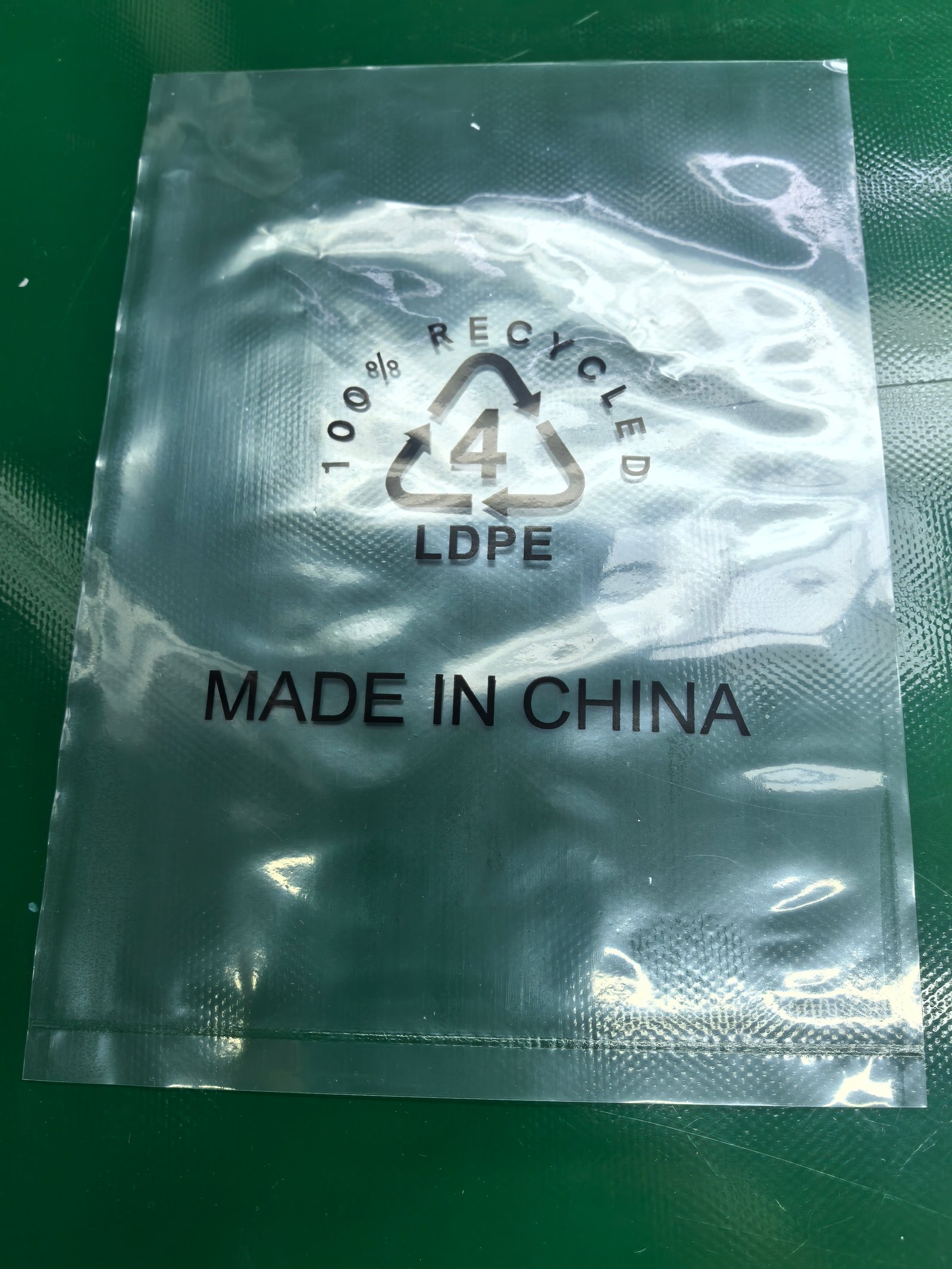
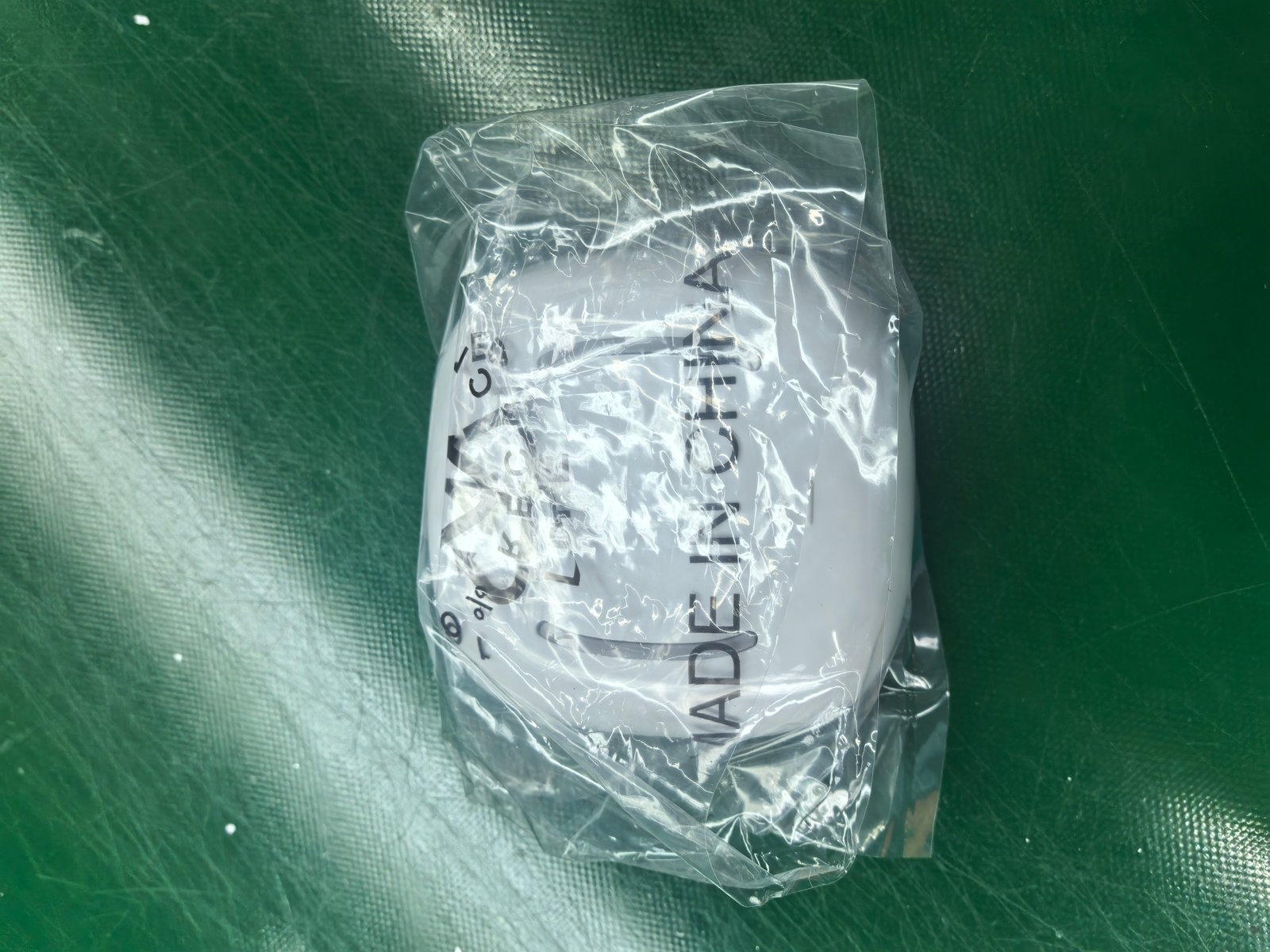
    Our 100% recycled LDPE packing bag holding a finished product. The product itself is marked MADE IN CHINA; the transparent bag shows the item without extra packaging bulk.

    Close-up of the same packing bag, printed with 100% RECYCLED, resin code 4 (LDPE), and MADE IN CHINA. The resin code identifies low-density polyethylene, a standard recycled packaging material.

    Our shipping bags are 100% recycled LDPE. It says so right on the film — “100% RECYCLED” plus the resin code 4 triangle. That is a small detail, but it is a visible one. A factory that bothers to source recycled packaging is usually a factory that thinks about waste in places a buyer would never ask about.

    The bag and the part are not the same rigor. Packaging LDPE is a forgiving application. A medical-device shell or a tight-tolerance structural part is not. The philosophy is the same — use less virgin material where it makes sense — but the engineering discipline is very different. We do not confuse the two.

    Where we say no

    Green is not always the right answer. Some specs demand virgin-only resin. Some parts have optical or cosmetic windows where recycled lot variation would show. In those cases, the honest call is to make the part in virgin material.

    A supplier that always says yes to “green” is not necessarily a green supplier. They might just be a supplier that will take the order and sort out the failure later. We would rather lose a part than ship a part that fails.

    What to ask your supplier

    • Can you show me the green-electricity certificate for the plant?
    • Where does your recycled material come from, and what incoming tests do you run?
    • Are there jobs where you will not use recycled material? How do you decide?

    If the answers are specific, you are probably talking to a factory that has thought it through. If the answers are vague, “green” is probably just a marketing color.

    Lower carbon, same standard

    Sustainability only works if it does not come at the cost of quality. Our job is to make the lower-carbon choice the reliable choice — whether that means certified green power, traceable recycled compound, or a shipping bag that carries its own proof.

    See how that responsibility shows up on our floor at our sustainability page and how it connects to our quality system at our quality page, and what our process actually covers at our capabilities page. When you are ready to talk about your next project, start here.

    Tip 4 in this series: We do not guess. We measure. — how precision is held by measurement, not by machine list.

  • Module 1

    Every mold has its ID, its log, its place.

    Part 6 of 9 · Supplier checks for buyers

    Every mold has its ID, its log, its place.

    Why mold discipline tells you more about a supplier than their machine list

    Most buyers judge a molding shop by what they can see in the lobby: the showroom, the brochure, the row of machines. None of that tells you whether your part will stay consistent in month eighteen. For that, you have to look at how the supplier treats the one thing that actually makes your part — the mold.

    The mold is your product’s twin

    Every plastic part you receive for the life of your program is born from one block of steel. The mold decides the wall thickness, the fit, the surface, and how much the dimensions drift over a million shots. If the mold is tracked, logged, and cared for, your quality is tracked with it. If it is not, no amount of inspection at the end can fully recover what was lost at the start.

    So the first question is not “how many machines do you have.” It is “do you know exactly which mold makes my part, and what its history is?”

    An ID is not a sticker

    A disciplined shop gives every mold a number, and that number connects to a file: the original drawing, the steel certificate, the cavity dimensions, the maintenance record. You should be able to point at a part and ask “which mold made this,” and get an answer that leads to a document — not a shrug.

    When a supplier can’t tell you which mold ran your order, you can’t tell whether the right mold ran your order. Traceability is not paperwork. It is the difference between a managed process and a lucky one.

    The log is the truth

    A mold that has run a million shots without a record is a mold nobody is watching. Precision shops log the things that matter: when the steel was last re-checked, what was repaired, which dimension was adjusted, and how many shots are on the clock. That log is what lets them catch drift before it reaches your parts.

    This is the same discipline behind measurement on the bench: a dimension is only useful if someone reacts to it. A mold log is only useful if someone reads it and acts. Good equipment does not manage itself. The management does.

    Its place matters too

    How molds are stored tells you how much they are valued. Molds stacked in a corner, unmarked, get damaged, confused, or run by mistake. A shop that stores them labeled, protected, and findable treats the tool — and your program — as something worth protecting.

    You can learn a lot in thirty seconds on the mold rack. If it looks like a junk drawer, the production probably does too.

    What to ask on your next visit

    • Can I see the file for the mold that would make my part?
    • When was it last dimensionally checked, and what did the check say?
    • How do you make sure the correct mold runs for my order — and not a lookalike?

    If the answers come with a document, you are looking at a managed shop. If they come with hesitation, the mold — and your part — may be running on hope.

    Discipline you can verify

    A supplier’s quality is easier to believe when you can see the system behind it. See how our quality controls are built and what our process actually covers. When your drawing is ready, start a project with us.

    Tip 5 in this series: A factory that breathes. — what “green” means on our floor, and where we say no.

  • Module 1

    What engineering support do you give before tooling?

    Part 7 of 9 · Supplier checks for buyers

    What engineering support do you give before tooling?

    Why the review before the steel is cut matters more than the tool itself

    Some molding problems are baked in at the start — a wall too thin to fill, a gate that leaves a mark, a draft angle that fights ejection. Once the mold is cut, fixing them means cutting again. The suppliers worth talking to earn their fee before the tool exists, not after.

    DFM is not a favor

    DFM — design for manufacturing — is the review a supplier does on your drawing before quoting. They look at wall thickness, draft, gate location, ejection, sinks, and warpage, and they tell you where the part will fight the process. A shop that only says “send us the file and we’ll quote” is skipping the step that decides whether your part will actually mold well.

    You don’t need to be an engineer to benefit from this. You need a supplier willing to say “this won’t work, and here’s why” before you’ve paid for a mold.

    Material and process fit

    A good supplier helps you choose the resin and the process window for your application, not just “what we have on the shelf.” The same part can behave very differently in two grades of the same polymer. The right call depends on your load, your environment, and your cosmetic needs — and a supplier who engages on that front is a supplier who understands your part, not just their machine.

    Proof before commitment

    Before a full production mold, can they prove the concept? A soft tool, a 3D-printed check, or a small first-article run can show whether the design fills, holds dimension, and assembles. Catching a flaw at this stage costs a fraction of catching it after the steel is cut.

    This is management, not machinery. The best press in the world won’t save a part that was never reviewed. Precision comes from the loop — review, prove, tool — not from the equipment list.

    What to ask before you pay for a mold

    • Will you review my drawing for moldability before quoting, or only after?
    • Who does that review — an engineer or a salesperson?
    • Can you show a past case where you caught a problem before tooling, and what it saved?

    If the supplier engages early and shows their reasoning, you are buying engineering, not just capacity. If they rush to a number, you may be buying a problem.

    Support that starts early

    A supplier that helps before the mold is cut is a supplier that cares about the part, not just the order. See what our process covers, and when your project is ready, start a conversation with us.

    Tip 6 in this series: Every mold has its ID, its log, its place. — how mold discipline shows whether a shop manages its tools or just owns them.

  • Module 1

    Walk the floor before you trust the shop.

    Part 1 of 9 · Supplier checks for buyers

    A practical first check for plastic injection molding suppliers

    If you’re scoping a plastic-injection-molding supplier without an engineering background, you’re far from alone — and you’re not helpless. You don’t need to read a spec sheet to sense whether a shop is run well. The floor tells you — if you know what to look for. This is the first of a short series of practical tips for non-technical buyers.

    When the part has to be right and on the dock when promised, a polished PDF is not proof. The floor is. Here is the easiest place to start.

    The corners tell the truth

    The tour path is what a shop wants you to see. The corners are what it can’t hide. A clear main aisle is easy to stage for a visit; order that reaches behind the machines, under the bench, and into the spaces nobody walks you down is the real thing.

    A clean, organized floor is not decoration. It protects your part and your delivery date — a clear floor means the right tool is found on time, the right label is read on time, and the shipment leaves on time. That is why a shop that only tidies when a customer is coming still betrays itself in the details: a scuffed surface, a missed label, a late shipment. Order that only appears on the main path is staged; order in the corners is real.

    When you walk a shop, check the places a host won’t point to. A practical checklist:

    • Behind and beneath the machines — are there stray bins of scrap, offcuts, dust, or oil building up where nobody stands? Corners that collect grime are corners nobody owns.
    • The gaps between machines and the edges of benches — leftover tools, unlabeled work-in-process, or personal items left from the last job? Disorder here reaches your part directly.
    • Aisle lines on the floor — are they clear, or blocked and faded, ignored when a forklift needs to pass? Lines that nobody respects are a signal the system is loose.
    • The shadow board for tools — empty outlines and missing pieces mean tools drift, and a missing tool is a delayed job.
    • Consumables — gloves, rags, solvents: returned to a marked place, or dropped wherever they were last used?
    • Housekeeping on a random day vs. a visit day — is it the same? A floor that switches on only for a tour is telling you exactly what you need to know.

    None of these are trivia. Each one is a small signal of whether the system behind your part is real, or only performed when someone is watching.

    What to look for beyond the floor

    The shop tells you more than cleanliness. A couple of things worth your attention:

    • Mold storage with an ID and a log for each cavity set — so the tool that ran your part last year is the tool that runs it next week.
    • In-process labeling on work-in-progress, so a part is never anonymous between molding and finishing.

    None of these are decorations. Each one is a small signal that the system behind your part is real.

    We don’t build showrooms. We build trust.

    That line is on our homepage because it’s how we operate. We would rather you walk the floor and decide for yourself than have us talk you into a promise we can’t keep.

    We welcome you to walk our floor — and to compare it with any other shop you’re scoping. Anytime you come, this is just our normal state: an organized, consistent, quietly precise floor, every day, not a performance for a visit. See our factory floor for yourself.

    That’s why buyers walk the floor — and stay.


    This is tip 1 in our Supplier checks for buyers series — practical tips for buyers without a technical background. Next: Listen before you trust the tool — how the sound of a molding shop tells you more than its machine list.

  • Module 2

    After the Nepal Landslides: A Disaster, and the Climate Account We All Share

    The past few summers have been hard to ignore. Heat records fall, weather patterns turn strange, and the conversation about the greenhouse effect keeps sliding between urgency and denial — including a stretch when the United States stepped back from the Paris Agreement and the case for cutting emissions was openly questioned. None of that is settled, and reasonable people still disagree about pace and policy.

    But here is the part that is no longer theoretical: the disaster has already arrived, and its consequences are already on the ground. Whatever one believes about how fast we should decarbonize, the landslides in Nepal are a reminder that the bill comes due for everyone, not only for those who caused it. That alone is reason enough to pay attention, and to do what we can.

    There is a chain worth being honest about. What came down in Nepal was meltwater, not rain — the landslides and outburst floods were driven by glacial melt, as warming ice let go of water it had held for a long time. Behind that sits a climate that is warming faster than the averages suggest. Behind that sits a century of rising global emissions. And behind that sits the combustion of fossil fuels that powered a great deal of the growth we now take for granted.

    We should be careful here. It is easy, and wrong, to point at one landslide and say “this was caused by emissions.” The honest version is smaller and more durable: the probability shifts, the trends point one way, and the direction is not random. A warming atmosphere does not author a single disaster. It loads the dice.

    That is the part that should trouble us. The climate account is shared, but it is not settled evenly. Every ton of carbon is a small withdrawal from a balance we all hold in common — and the communities that lose the most to a changing climate are too often the ones who put the least into it.

    What changes things is everyone’s effort, added together. And whether or not it changes the outcome, taking part is the point — our participation is the only honest answer we have to a problem none of us caused alone. The account is harder to forget when more people see that showing up matters.

    For our own part, this is why we began moving toward cleaner electricity in 2018, and have used recycled materials for years.